
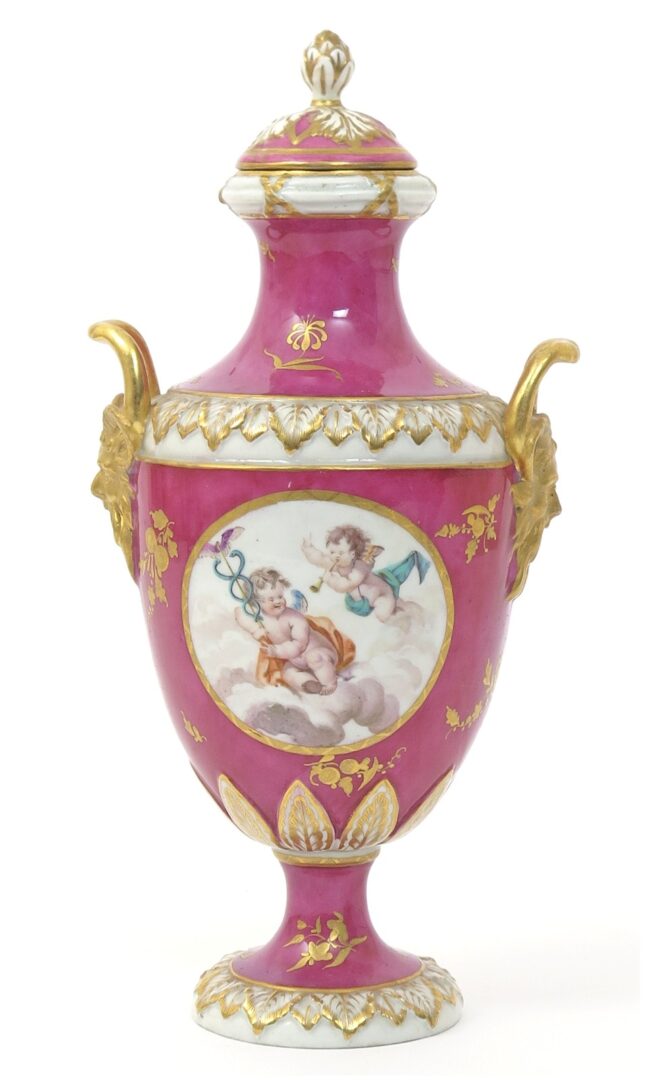
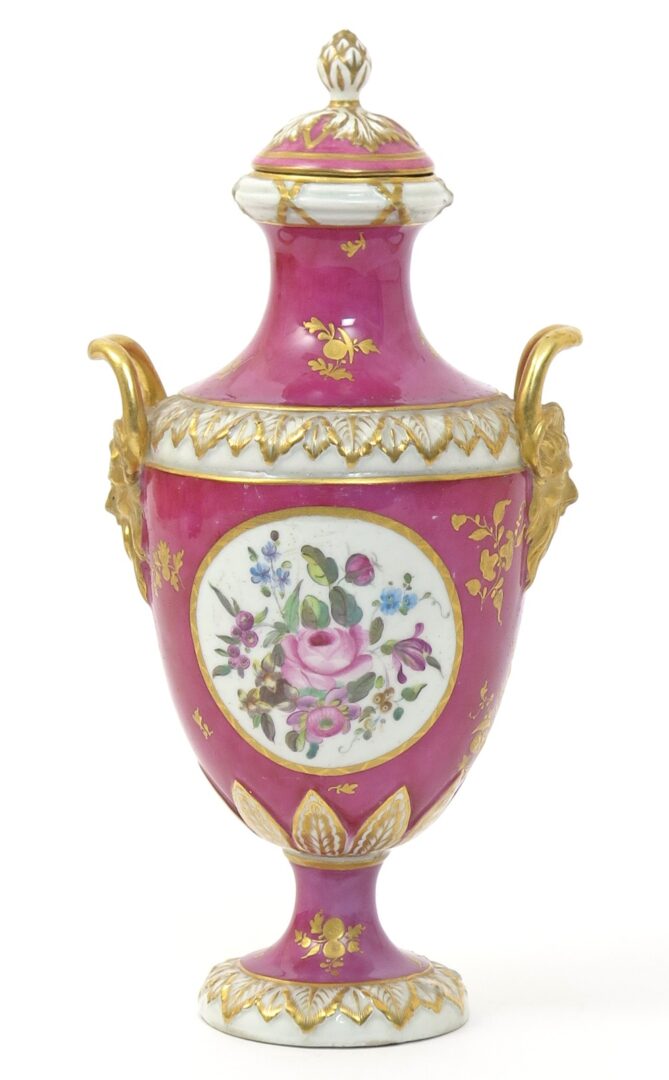
1, 1b A Chelsea-Derby vase and cover c.1768, one side painted by Duvivier with two putti (1a), one holding a caduceus, the other blowing a trumpet. The reverse (1b) shows a panel of European flowers, reserved on a claret ground with scattered gilt flowers, the shoulders with two handles issuing from satyr masks. H 28.5 cm. Photo: Woolley & Wallis, Salisbury, England(i)
Fidelle Duvivier arrived in England for the first time in late 1768 or early 1769, coming from Sceaux near Paris, where he had worked for about two years, decorating Sceaux faience and Mennecy porcelain.(ii) Soon he was hired as a porcelain decorator by William Duesbury I, as confirmed by the surviving four-year contract signed by Duvivier on 31 October 1769. Duesbury purchased the Chelsea factory in February 1770 and had his painters also decorate leftover Chelsea white wares, proudly advertising Duesbury & Co. as “Manufacturers of Derby and Chelsea Porcelain.”
Although it has long been known that Fidelle Duvivier worked for Duesbury during this “Chelsea-Derby” period, there was never an attempt in older Derby literature to attribute any early Derby decoration to him. In the 1940s the prolific but not always reliable researcher Major William H. Tapp published several articles about his study of the Duviviers in the art magazine Apollo. Prior to these he had written an article in 1934 in Connoisseur, in which he formulated his theories about another painter, Richard Askew (c. 1730-1798), who had worked at Derby as well. Tapp wrote he had found Askew’s name mentioned in certain Derby wage lists dating to 1769/1770, and again in later factory pattern books of 1794-95, in which he is referred to as the painter of “cupits” (sic). Tapp claimed that Askew had an agreement with Duesbury dating from 1772 (for which documentation is lacking), and he suggested that Askew was working at Derby for the entire period of 1770 to at least c. 1780. But that is not true. Moreover, it has led to far too many “cupits” being attributed to Richard Askew when a substantial number of them were actually done by Fidelle Duvivier.
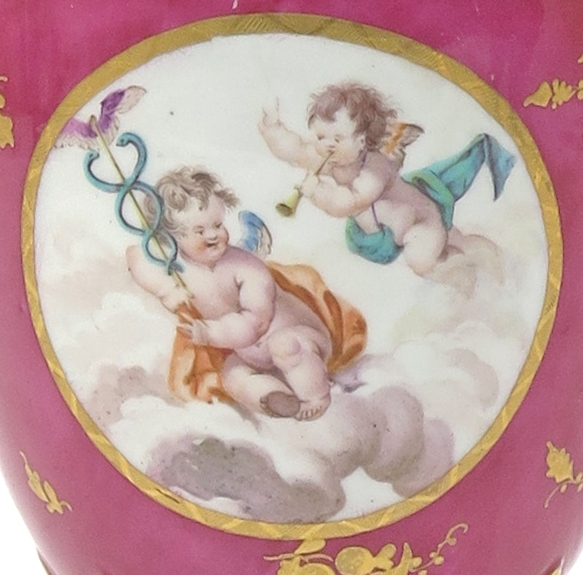
1a Detail of the cherubs on the Chelsea-Derby vase (above). At right, another similar vase (2) also decorated by Duvivier, the shape strongly resembling the one shown in 1. It is in the collection of the Metropolitan Museum of Art in New York. Similar flowers are also painted on the reverse, as in 1b.
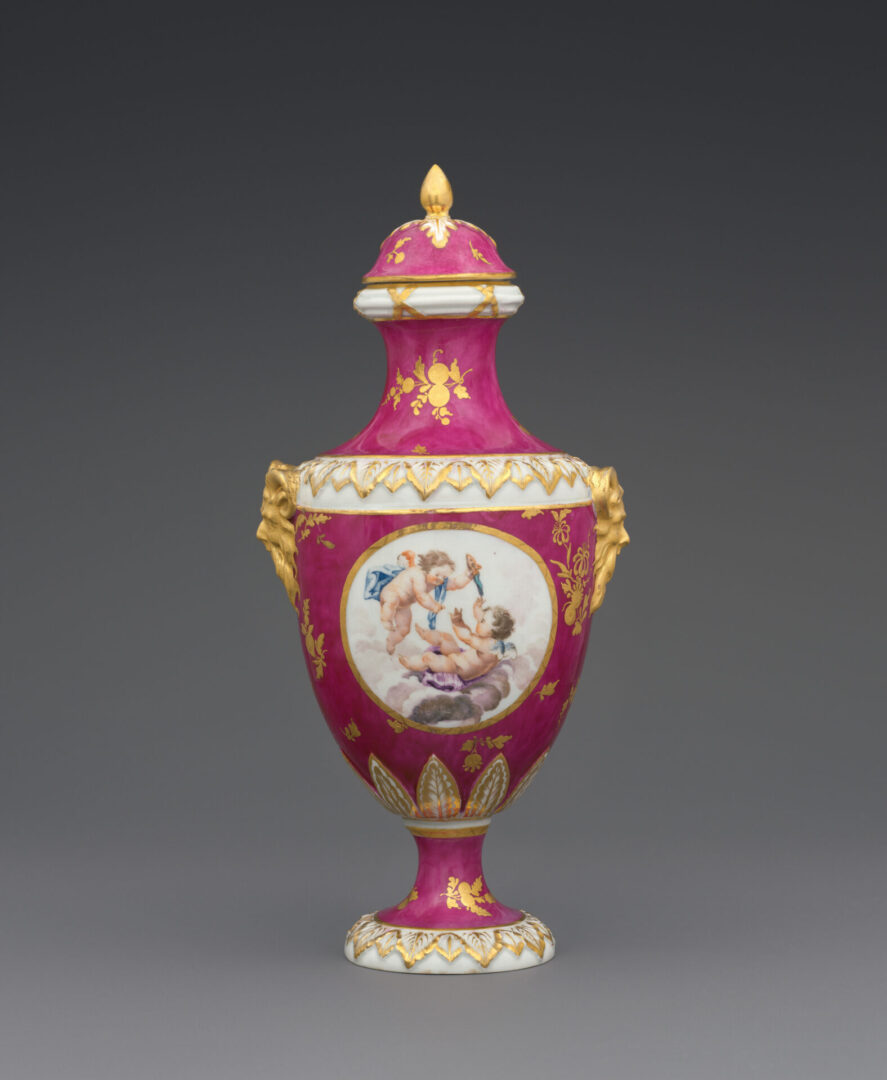
2 (Acc. no. 14.58.114). H 28.9 cm. (Other pictures can be viewed online).
In 2011 Andrew Ledger, an archivist at Derby who had investigated early records, had his findings published and reported that Richard Askew was only sporadically in Duesbury’s employ during 1769 until April 1771, according to surviving Chelsea wage bills. Moreover, by April 1772 he was living in London and did not return to or work for Derby again until about 1794. For Ledger it was clear that Askew could not have painted ‘cherubs on clouds’ over a period of 22 years. His verdict: “This invalidates all attributions to Askew of the decoration of any Derby products dated from April 1772 to mid-1794.”(iii)
Despite this, most Derby putti or cherubs continue to be attributed to Askew without hesitation, an untenable standpoint in the meantime. Derby expert Sir Stephen Mitchell wrote in The Marks on Chelsea-Derby, “Although traditionally ‘cherubs on clouds’ decoration in camaieu rose is attributed to Richard Askew, there is now a strong case for attributing certainly some of that work to Fidelle Duvivier … ” and he included several convincing attributed examples on a CD accompanying his book.(iv)
The ability to recognize Duvivier’s work comes with gaining a familiarity with his favoured painting techniques and repetition of details. While searching for his decorative work in various countries, I noticed that Duvivier painted these popular putti or cherubs in Boucher’s style at nearly every manufactory where he worked – on Sceaux faience and Mennecy porcelain, then at Derby, and again (after his return to France) on Sceaux porcelain, followed by some of his finest on Loosdrecht porcelain and Hague-decorated Ansbach porcelain, with just one added New Hall example from his later years in Staffordshire. These helped me to see the stylistic connections to his work on Derby coffee and teawares, and in my book Footsteps I included several attributions with a discussion of some of the typical characteristics to look for in this category of Duvivier’s decoration.(v)
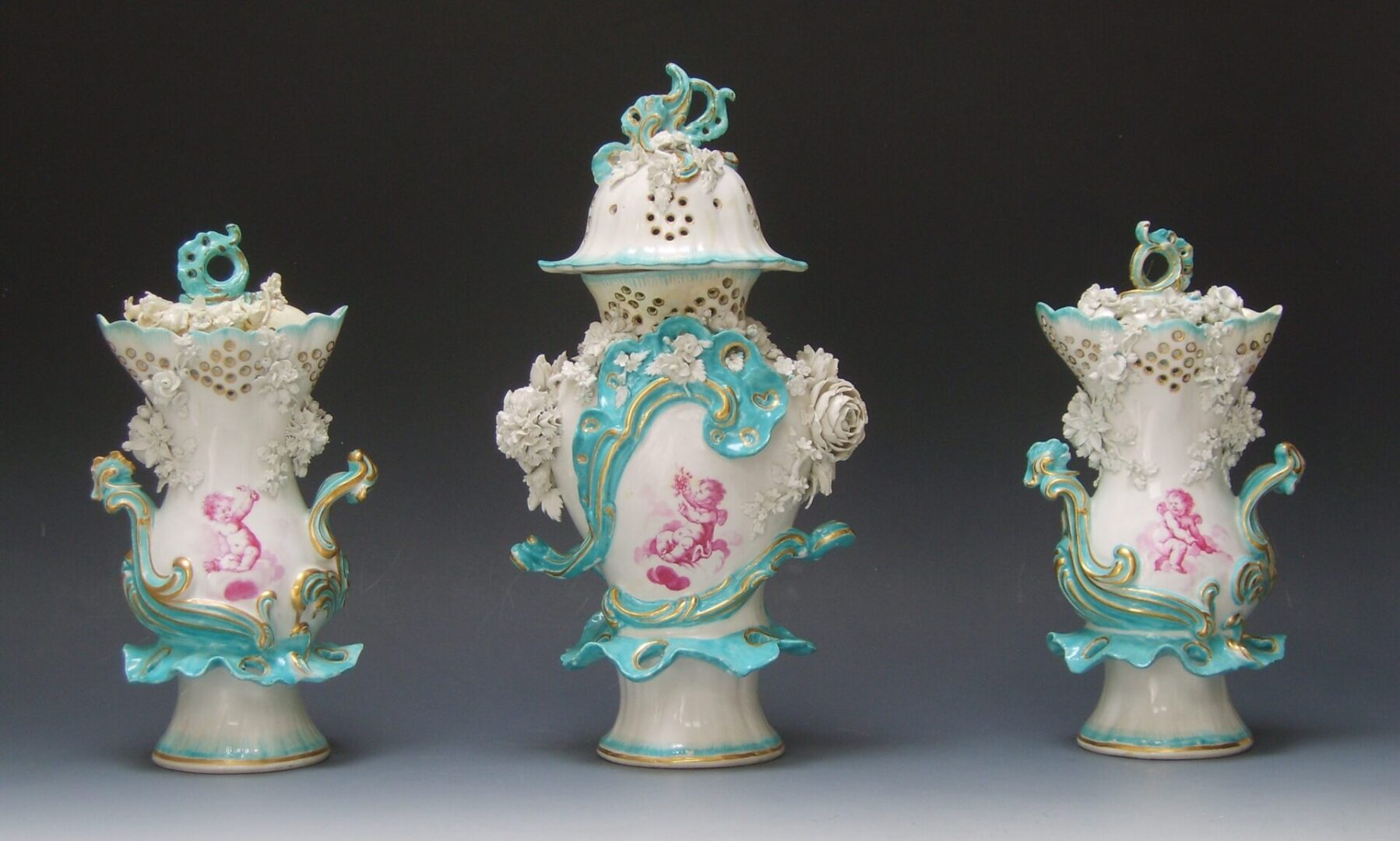
3 “A garniture of three Derby potpourri frill vases and covers, c. 1770, with puce monochrome scenes of putti at play, within applied rococo scrolls in turquoise and gilt, and large applied flowers in white, the necks and covers pierced with arrangements of small holes, H of middle vase 30.5 cm, the other vases 23 cm.” (Putti decoration on front and reverse by Fidelle Duvivier). Photos: Rod Jellicoe
His winged enfants also appear on pairs and garnitures of Derby porcelain “frill” vases. A few years ago I corresponded with London dealer Rod Jellicoe regarding this garniture (3) at his website, which showed three Derby potpourri vases adorned with putti that I was sure were painted by Duvivier. He kindly sent me photos and I pointed out to him some of the typical details in the eyes (simple lines with solid vertical ovals below them), the delicate bodily shading, as well as a pose his putti often assume with one leg cocked or bent and the foot pointing inward (see 3a as well as 1a). They are painted in a soft puce or rose camaieu and nearly always seated on clouds with a dark spot in front, as shown below (3a, 3b, 3c).
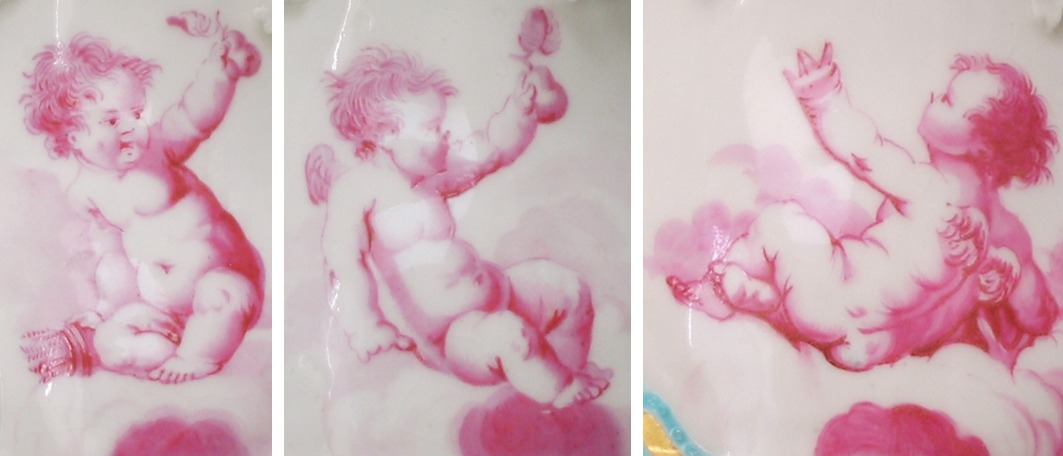
3a, 3b, 3c
In 1971 the Derby authors Barrett and Thorpe had commented that a “very fashionable decoration was that of cupids or putti, usually painted amongst clouds in rose camaieu, that is to say in different tones of the same colour. Richard Askew is generally regarded as the artist responsible for these endearing cherubs … [A] notable example is to be found in a set of vases, decorated with applied flowers, from the Hurlbutt Collection now in Derby Museum (Plate 117).”(vi)
I would firmly attribute the cherubs on these two Hurlbutt vases (4) at the Derby Art Museum and Gallery to Duvivier, not Askew, because of the familiar stylistic characteristics mentioned and their similarity to other Duvivier examples.
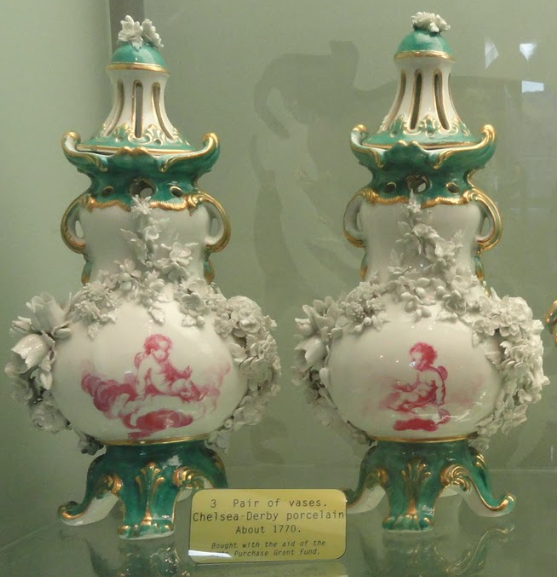
4 A pair of Derby potpourri vases with encrusted flowers as shown here could have been added to a set of three to form a 5-piece garniture. The museum correctly dates these to c. 1770, when Duvivier was active at Derby. H 28.5 cm. Derby Art Museum and Gallery.(vii)
While the number of Duvivier attributions increases, there is still one problem: there are cherubs on clouds rendered in a deep carmine or dark purple enamel on Derby objects dating from this period, around 1770, and whoever the decorator was, his chunky cherubs with puffed cheeks and darker bodily shading stand in stark contrast to Duvivier’s softer, more delicate compositions. To illustrate, the two examples below (5, 6) were done by another contemporary Derby putto painter or painters (although they might be by the same hand because the cloud painting on each looks very similar in style). These figures appear on the types of wares Duvivier was also decorating during that time: they adorn a Derby frill vase and a dessert plate, respectively.(viii)
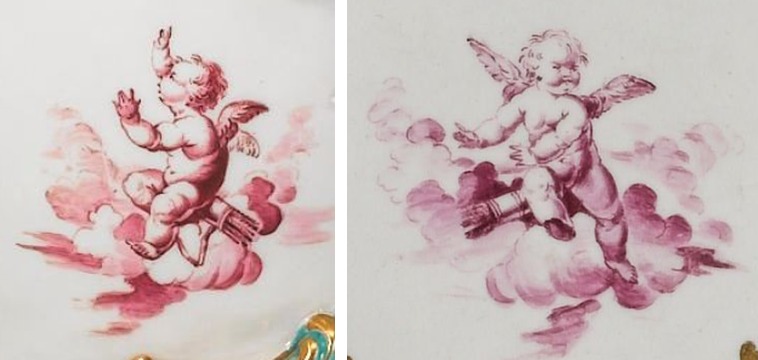
5, 6 (NOT by Duvivier) The facial features, larger wings, and darker body shading as well as the less ethereal cloud formations point to a different painter’s hand.
For years we have been encountering the phrase “done in the style of Richard Askew” in literature and lot descriptions whenever a Derby object with cherubs was featured in a collection or an auction sale – whether they resembled those in 5 or 6, or were actually unascribed Duvivier creations. It will remain a kind of “default” phrase until the newer published research becomes more widely known and consulted. But what do we know about Askew’s style? Are there any examples of this type of Derby decoration that could be positively identified as his? Geoffrey Godden owned one: a richly painted Derby caudle cup and stand in his Reference Collection (7a, 7c), and they were published in several books.(ix)
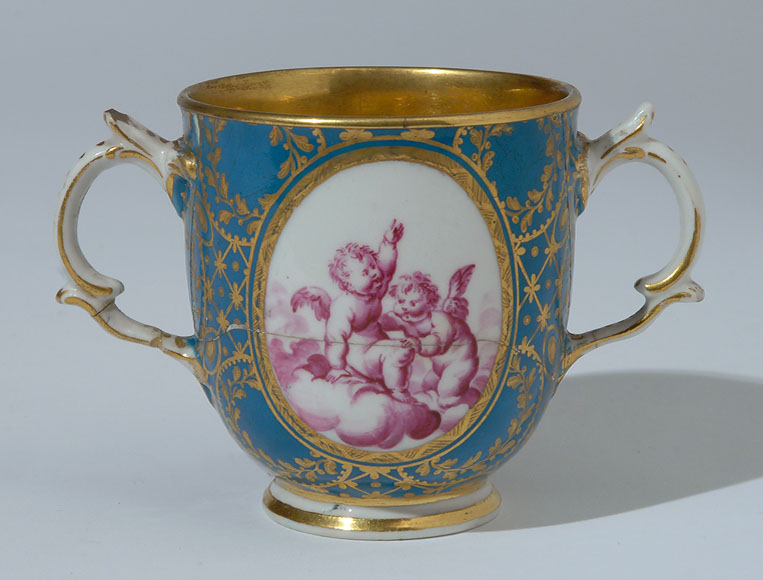
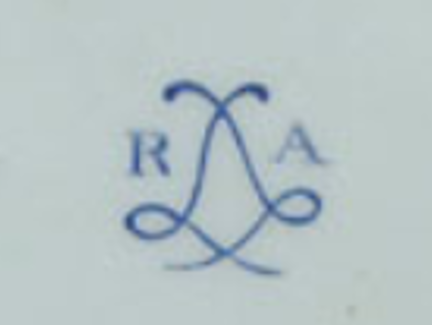
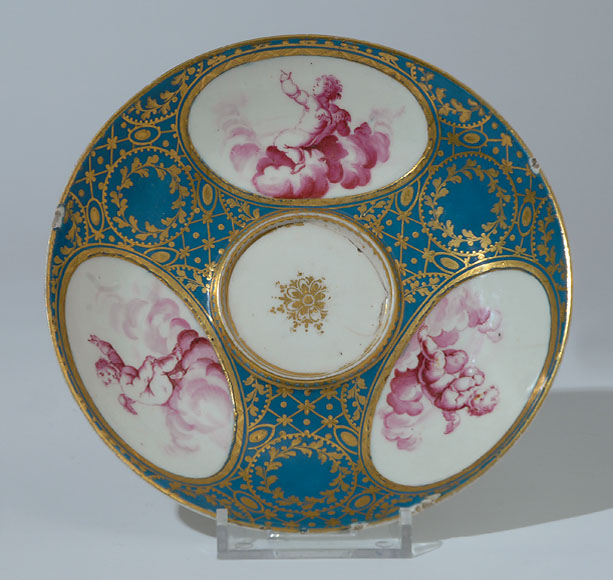
7a “A caudle cup and stand painted with cupids on a turquoise ground richly gilt. Stand 14.2 cm diam., Sèvres interlaced Ls mark flanked by initials RA” (7b). Both the cup and the stand (7c) have the same mark on the base and the reverse (at right). They were auctioned by Bonhams, London on 13 Nov. 2013, lot 2019, and are now in a private collection. Photos: Sir Stephen Mitchell
7b
7c
These important documentary pieces were on loan to the Potteries Museum in Stoke-on-Trent for a few years before being sold in 2013. Godden dated them to 1770-1775 and wrote, “I firmly believe that the initials so neatly painted with the Sèvres mark relate to the painter Richard Askew… .”(x) If Askew painted these pieces, they would date to between 1769 and April 1771, taking into account Ledger’s newer research regarding his employment at Derby.
Looking at the five cherub examples on that cup and stand (7a, c, d), we should compare them to those on another important Derby two-handled cup and stand (8), gifted to the Bowes Museum in 2003 along with over 400 other pieces of the Lady Ludlow porcelain collection.(xi) This cup and stand bear the gold anchor and D marks, whereas the “Askew” pieces have a personalized painter’s mark, suggesting that they were perhaps not for sale, but kept for show, i.e. to demonstrate the painter’s skills.(xii) The elegant Lady Ludlow example is decorated by Duvivier and therefore must be dated to the 1770-73 period, and not as late as c. 1780.
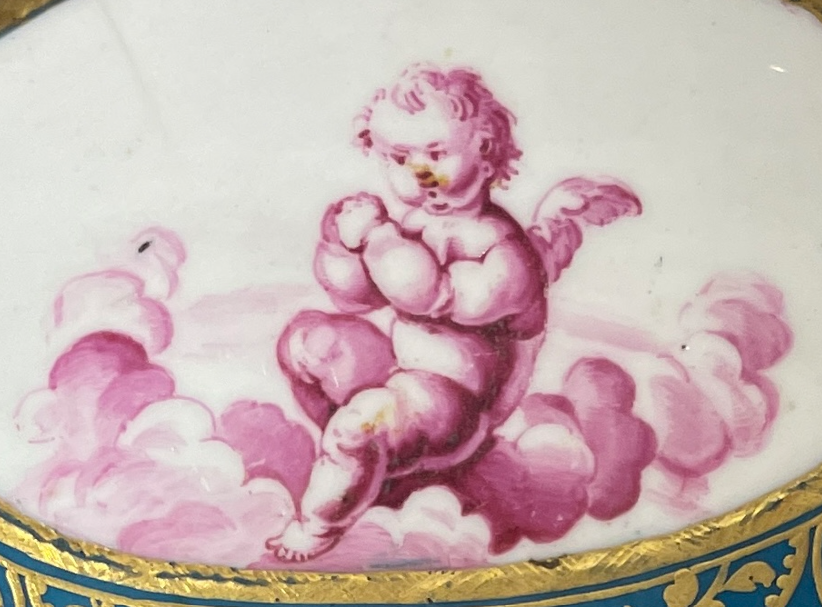
7d Detail of a cherub on clouds presumably painted by Richard Askew in one of the three reserves on the former Godden Derby stand shown in 7c.
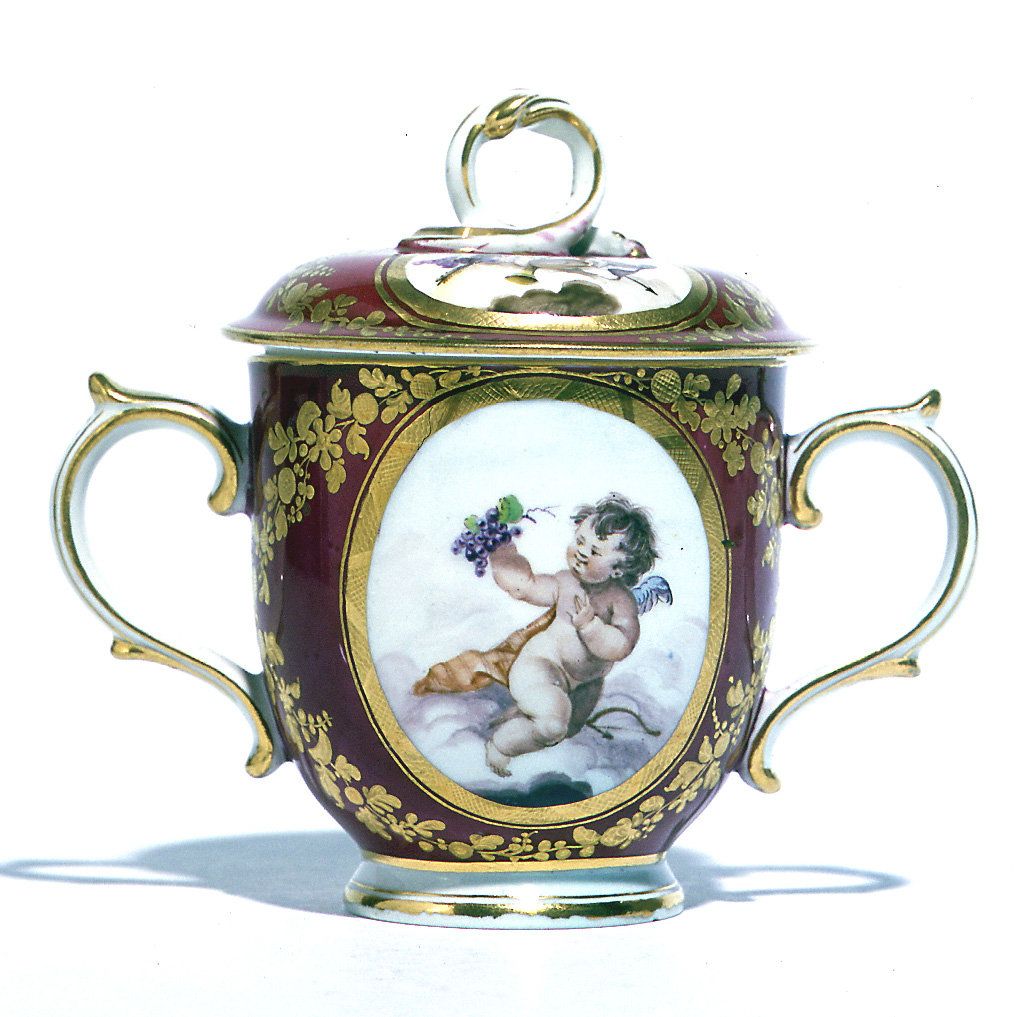
8a Detail on the Derby cup shown below in (8), painted by Fidelle Duvivier.
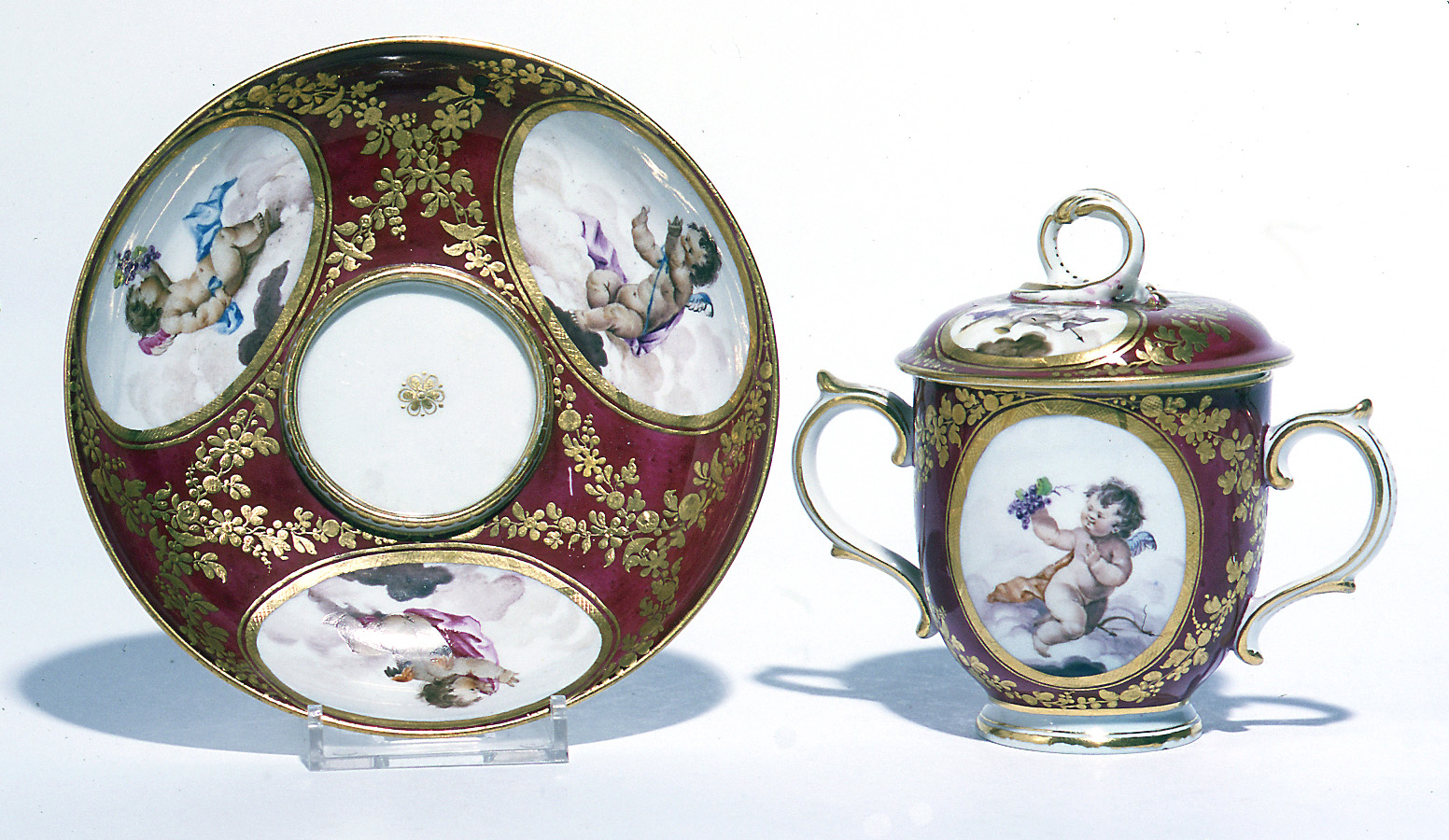
8 A Chelsea Derby two-handled cup with cover and saucer decorated with a claret ground and reserves of cupids and music trophies, ca. 1770-73, by Fidelle Duvivier. Conjoined D and anchor mark in gold. H cup 7.4 cm, with cover 10.9 cm; Diam. saucer 14.1 cm. (2004.120/Cer). © The Bowes Museum, Barnard Castle, Co. Durham, England.
For more Duvivier examples, see my book and the other blogposts at my website featuring porcelain with his ‘cherubs on clouds’. They include those displayed at museums in the US, the UK or sold at British or European auctions.(xiii)
NOTES
(i) Auctioned by Woolley & Wallis, on 28 Feb 2017, lot 438. It was doubtless one of a pair, but the pendant is missing. Although the second vase in the Metropolitan Museum of Art (2) comes close as a candidate, the finial and handles are different.
(ii) His older brother Michel-Joseph had worked for the Chelsea porcelain manufactory for several years, both as a decorator and as their artistic director. He had married there and fathered one daughter, but returned to Tournai ca. 1763 as a widower with his only child, Amélie. For more information see Charlotte Jacob-Hanson, In the Footsteps of Fidelle Duvivier (Tucson, Arizona: West Press, 2016). For genealogical notes, pp. 83-87. Her book can be ordered at www.chjacob-hanson.com.
(iii) Andrew Ledger, “Richard Askew, Derby painter: Unsafe Attributions,” Transactions of the English Ceramic Circle, Vol. 22, 2011, pp. 39-45. Ledger evaluated his findings in pertinent Derby documents (pp. 43-44): “Searches of the Chelsea wage bills 1771 have produced only four weekly bills recording wages paid to Askew amounting to 16 days work [between 27 April and 1 June]. Four entries over 5 weeks amounting to 16 working days means he was not ‘working regularly’ for Duesbury in this early period. … His only certain time working at Derby was for Duesbury II from about mid-1794 to end-1795 or perhaps early 1796 …. [This invalidates] all attributions to Askew of the decoration of any Derby products dated from April 1772 to mid 1794.”
(iv) Stephen Mitchell, The Marks on Chelsea-Derby and Early Crossed Batons Useful Wares, 1770-c.1790 (London: SGM Books, 2009), p. 36.
(v) See Footsteps, pp. 2-6, 28-30, 33-34, 65-69.
(vi) Franklin A. Barrett and Arthur L. Thorpe, Derby Porcelains (London: Faber and Faber Ltd., 1971), p. 46.
(vii) Photo: http://britseps.blogspot.com/2011/12/scouts-kids-classes-and-downtown-derby.html
(viii) The putto in 5 was on a Derby plate sold by Bonhams, London, on 7 Dec 2005, lot 239; and the other one in 6 appeared on a Derby potpourri vase belonging to a three-piece garniture last auctioned by Woolley & Wallis, Salisbury, on 2 May 2018, lot 506. Similar putti can be seen on two Chelsea-Derby dessert plates in the Walters Art Museum, Baltimore MD (accession numbers 48.833 and 48.834, online).
(ix) Geoffrey Godden, Eighteenth Century English Porcelain: A Selection from the Godden Reference Collection (London: Granada, 1985), p. 187, pls. 65-67, 157 and 154-156, color plate XVII; Stephen Mitchell, The Marks on Chelsea-Derby and Early Crossed Batons Useful Wares, 1770-c.1790. Chapter IX: A Sèvres-style mark, the “Dot Rose” painter and Fidelle Duvivier: outside decorators located in Derby c. 1768-1773?” (SGM Books, London, 2009), pp. 16-17, pl. 126C.
(x) Godden (1985), op. cit., p. 187.
(xi) Ann McNair, Catalogue of the Lady Ludlow collection of English porcelain at the Bowes Museum (London: Unicorn Publishing Group, 2007), p. 145 (no. 122).
(xii) There are other differences as well: the gilding of the interior of the cup (7a) and the slight variations in the handle shapes on both cups.
(xiii) See “Boston Museum of Fine Arts – Derby, Sceaux, Loosdrecht and New Hall porcelain with Duvivier decoration“ (Feb. 20, 2017); “More Cherubs on Clouds – painted in The Hague” (February 27, 2018); “Country togs, angelic faces” (August 15, 2018); “Some Duvivier decoration on Sceaux porcelain” (March 5, 2019); “A Mennecy Jug in a National Trust House” (May 10, 2019); “Duvivier at Derby – the clues and secrets of a Chelsea-Derby teapot” (August 31, 2020) – all are posted at my website www.chjacob-hanson.com under Gallery & Blog.